OSS has Changed. So has Dosu.
Changes coming to Dosu OSS plan on Sept 1st. ~96% of OSS projects see no change.

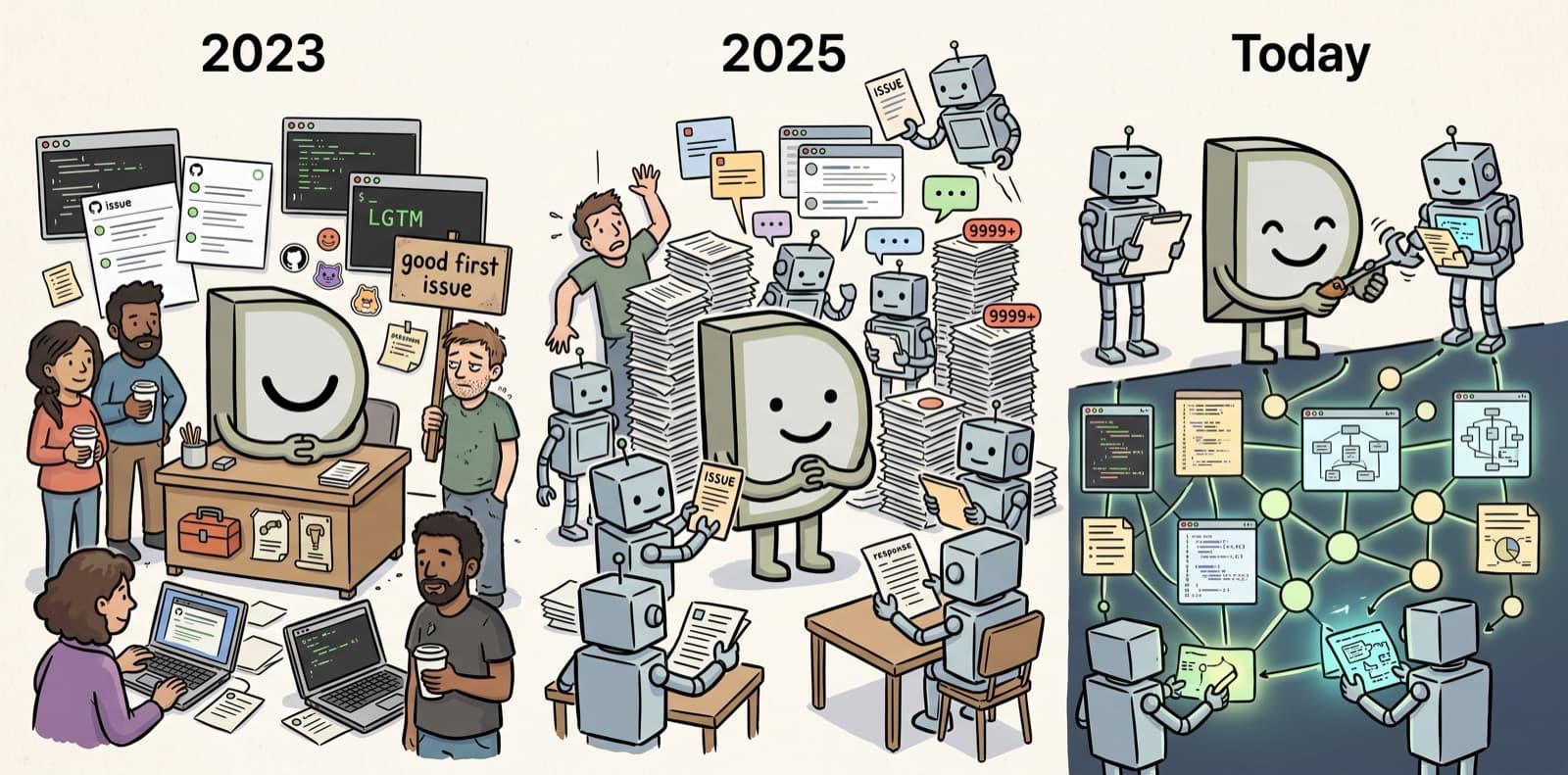
TL;DR: Dosu's unlimited free tier for open source is ending. ~96% of OSS projects will see no change. They'll simply move to the same limits as our standard free tier. High-volume projects (~4%) will need a paid plan. CNCF projects keep elevated limits, and paying open-core customers are unaffected. For issue triage going forward, we're partnering with Pullfrog to make migration effortless.
I love open source software. It's where most of my weekends and spare hours went before I started Dosu.
OSS was one of the places that made the internet feel small again, a place where you could have delightfully intimate interactions with strangers on the web (and ample hostile ones too 😅). It's these interactions and random acts of kindness that drove me to become a maintainer myself.
The downside of becoming a maintainer was time. I quickly became a bottleneck for information, waking up to dozens of notifications from users needing my input. Tens of thousands of developers depended on me for the context that only I had: how the project was built, why decisions were made, and what is and isn't in scope.
So back in June 2023, I started Dosu with the goal of using LLMs to extend the knowledge and memory that I, and every engineer, have to everyone who needs it.
🤩 Three years of OSS
Fast forward three years and Dosu's impact on OSS was bigger than I could have imagined. In that time, Dosu:
- Was installed on over 100k repositories with millions of total GitHub stars
- Reached millions of developers
- Saved developers tens of thousands hours and gave many more, much needed hours back to maintainers
- Became the first AI Agent approved for use within the Apache Software Foundation
- Partnered with the Cloud Native Computing Foundation
- Made it into LLM model knowledge as the go-to-tool for OSS overwhelmed maintainers
- And so much more!
We were able to accomplish all of this while providing Dosu to OSS for free, not only because I wanted to :), but because it gave us an incredible distribution flywheel: developers discovered Dosu on OSS projects, which would drive internal adoption at their (paying) companies.
However, in December 2025 something changed.
🔥 Rise of Coding Agents
The impact of coding agents on OSS has been written about extensively, so I'll keep this short.
Coding agents effectively eliminated barriers to contribute to a project, causing PR volumes to skyrocket to unmanageable levels. The story on GitHub issues and discussions, where Dosu operated, looked similar. (One interesting caveat is that issue volume actually declined on established OSS projects. Future blog on this!).
But like PRs, issues are now primarily opened, written, and responded to by agents. Dosu kept responding, but rather than delighting developers, it just became bots talking to bots. Volume increased, yet Dosu's impact lessened. The human interactions that led me to build Dosu for OSS, no longer exist in the same way.
OSS is not dead, but it's changed, and Dosu has too.
🧠 What's next
Since the beginning of this year, Dosu has been building the knowledge infrastructure agents need to capture and share what they learn as they work. As agents take on more work end-to-end, organizations need new primitives for how agents read, write, and maintain shared knowledge.
We think this is one of the most important unsolved frontiers for agents. Done well, better knowledge infrastructure makes agents more token efficient, faster, and intelligent.
We have a lot of ideas for how this could fit into OSS, but as a startup we need to remain focused, so we're not ready to prioritize them just yet.
📋 What this means if you use Dosu for OSS today
For those who use Dosu for answering questions and triaging issues within OSS, here is what you need to know:
- Most projects are unaffected. ~96% of OSS projects will fall within the standard free tier limits and will see no change.
- High-volume projects (~4%) will move to standard pricing. The unlimited free OSS tier is ending. These projects will need a paid plan to maintain their current volume or consider alternatives (see below).
- Paying open-core customers see no impact.
- CNCF projects keep elevated limits.
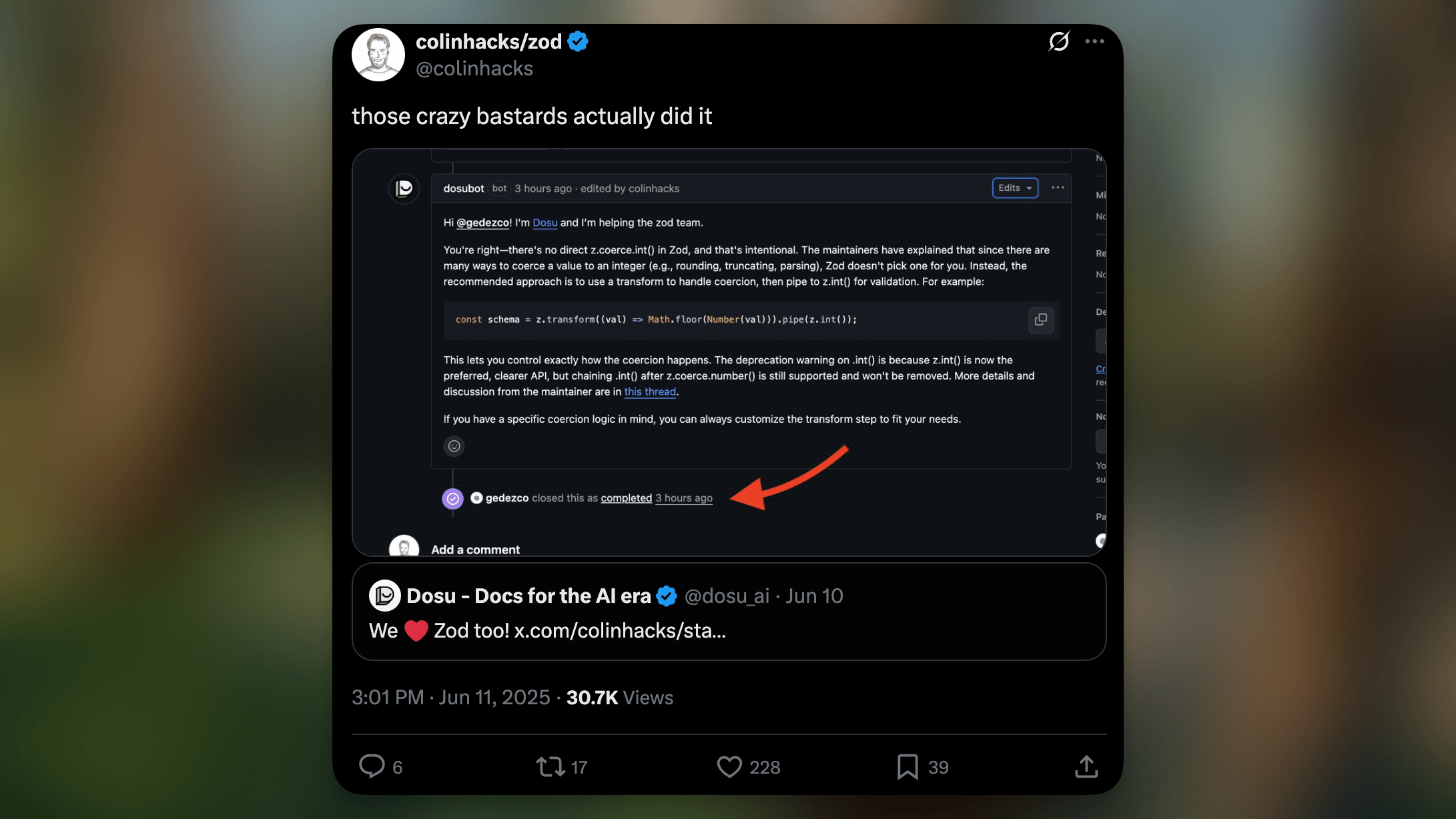
- OSS is still in good hands. We've partnered with Pullfrog, by the legendary Colin McDonnell of Zod/Nub fame, to make it effortless to adopt Pullfrog for issue triage within your repository.
And if you're excited about agent knowledge capture and sharing at your organization, please reach out to hi at dosu.dev!
🙌 Thank you
Thank you to the maintainers and communities who bet on us. Your feedback helped shaped what Dosu is today. We're looking forward to finding new ways to serve OSS in this new AI era.
-Devin
Found this article helpful?
Share it with your network to help others discover valuable insights.
Want more like this? Subscribe via RSS
Related Articles
How 20 Vercel AI SDK tickets drove the agent cost gap
Oct 6, 2026 / 17 min read
Claude Code on Opus 5.5 and Codex on GPT 6.1 Sol attempted the same 49 tickets. The recorded cost gap came entirely from high-scope work.
Procedural Memory for Coding Agents: Turning Knowledge Into Action
Oct 2, 2026 / 16 min read
Learn how to turn a coding agent's discovery into a shared procedure, choose where the instructions belong, and check that the next agent uses them correctly.
Semantic memory for coding agents needs a history
Oct 1, 2026 / 10 min read
Your coding agent needs to know which facts still apply. Our Celery-to-DBOS migration shows why semantic memory needs scope, dates, and source evidence.
Episodic memory for coding agents: What survives your sessions
Sep 29, 2026 / 14 min read
Episodic memory is a coding agent's record of past sessions. Saved lessons can outlive the transcripts behind them, so keep each lesson tied to its source.