Why Your Coding Agent Needs More Than a Static README
Vercel proved static context beats on-demand skills for coding agents. But static docs have limits, so we extended that principle with a living knowledge base and the Dosu MCP.


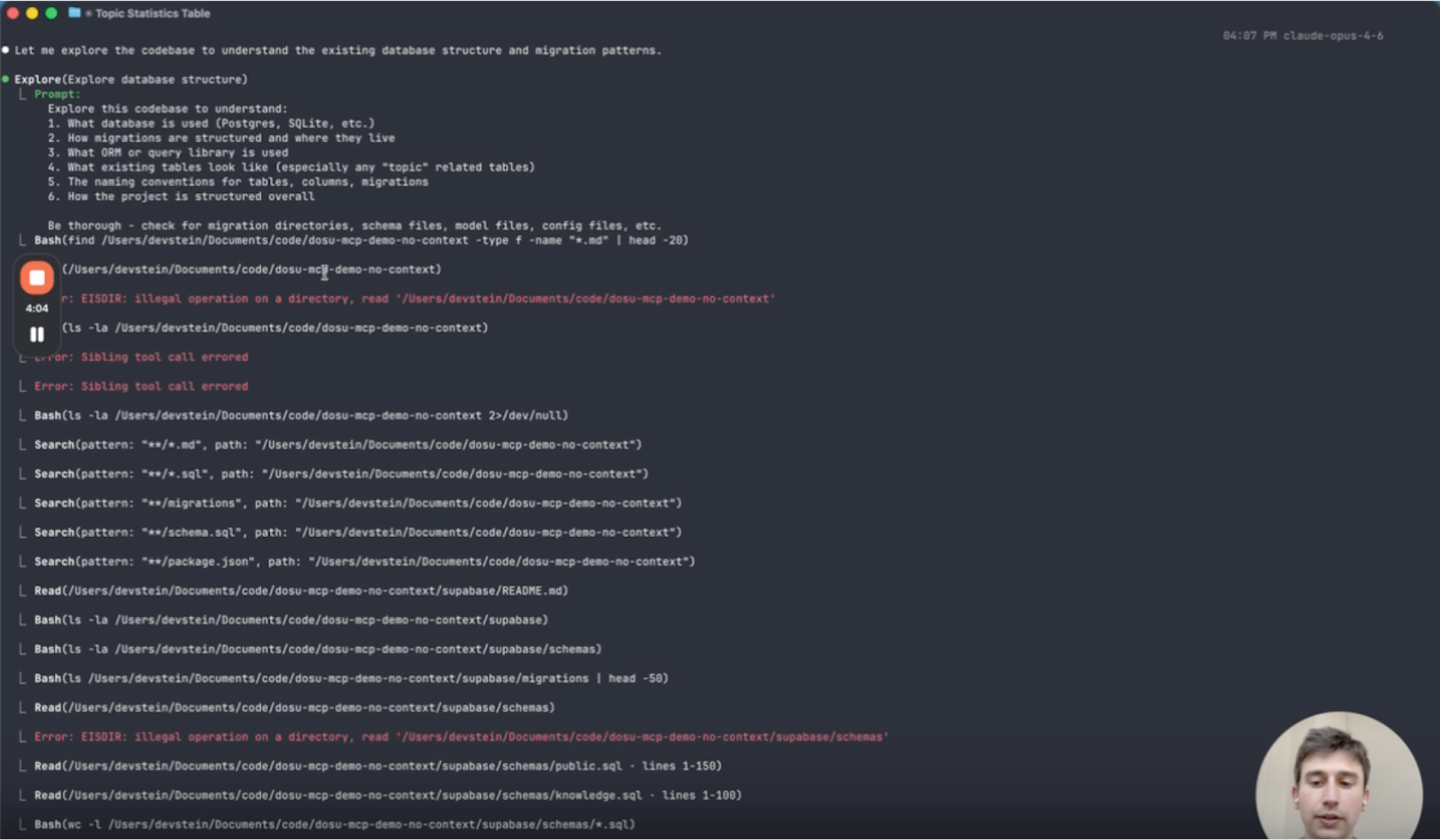
We like to think about coding agents as direct employees on our team responsible for building parts of our project. And like any new employee, they need proper direction when onboarded since without them, they can spend a significant amount of time (and tokens) trying to onboard themselves and usually end up at least slightly off target.
Vercel recently published research reinforcing this idea about AI coding agents. Their finding was deceptively simple: agents that always have documentation available outperform agents that have to decide when to look it up. Static context beats active retrieval. Their AGENTS.md approach achieved a 100% pass rate compared to 79% when agents relied on on-demand skills and compared to skills failing 56% of the time when the LLM failed to even invoke them.
But let’s take their findings a step further and imagine what would be possible if the AGENTS.md file could be up to date with all the latest context in addition to what you had initially inputted.
Static Docs Work Until They Don't
Vercel's AGENTS.md is genuinely better than nothing. An agent that always knows how connection() enables dynamic rendering, or which caching APIs exist in your Next.js version, is a more reliable collaborator than one guessing from training data alone. The "no decision point" principle matters: when documentation is ambient rather than on-demand, agents stop failing silently.
The problem is maintenance. Every time your framework version changes, someone has to remember to run npx @next/codemod agents-md. Every time your team adopts a new pattern or makes an architectural decision, someone has to open the file and update it. And imagine if your team has tens or even hundreds of these projects going at once. This is not a small task. Documentation debt accumulates fast, and a stale AGENTS.md can be worse than none. It gives your agent false confidence about things that are no longer true.
Static docs are also, by definition, flat. A single markdown file can tell an agent what an API does. It can't easily point to the PR where your team debated two approaches, the Slack thread where a senior engineer explained the tradeoff, or the load test results that sealed the decision. Documentation lives in many places. Compressing it into one file means losing most of it.
A Living Knowledge Base Can Point Where Docs Can't
A knowledge base that pulls from code, PRs, Slack, Notion, Confluence, and internal wikis can surface this kind of reasoning. It can connect "use connection() sparingly" to the actual cost analysis that motivated it, like the load testing that revealed 40% cost savings from standardizing on static generation for marketing pages, documented in PR #347. That's the difference between knowing a rule and understanding why the rule exists.
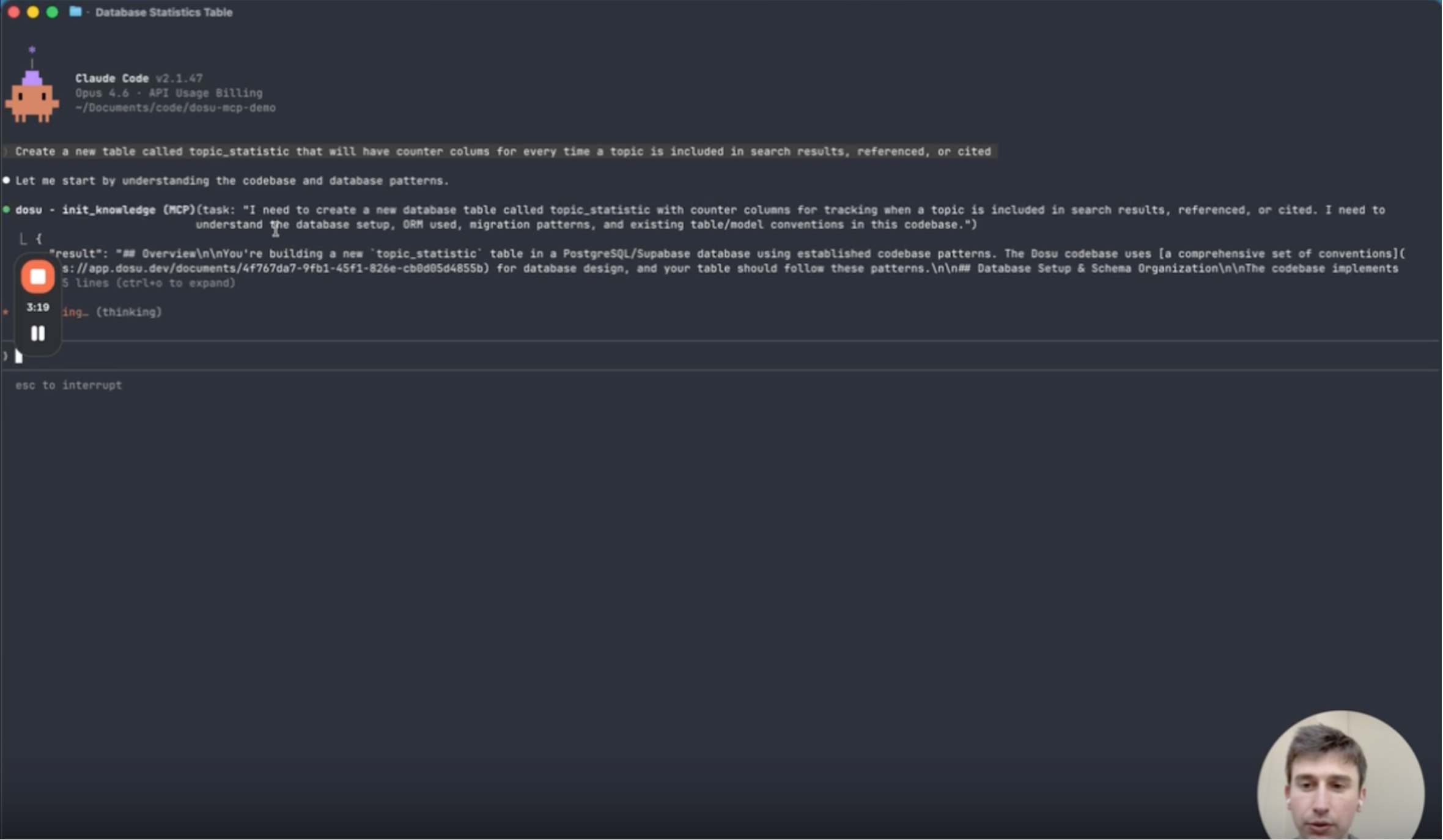
And connecting your coding agent to all these different data sources and ensuring the connection is maintained is no longer the pain it once was with the Dosu MCP.
Have your agent go from relearning the codebase for the 100th time to a simple Dosu MCP call:
The Counterargument Worth Taking Seriously
Not every project needs this. For a small team working on a single, well-defined codebase with stable conventions, an AGENTS.md file might be exactly right. It's fast to set up, easy to version control, and doesn't require any external tooling. Adding a full knowledge management layer introduces setup overhead and can pull in noise if the underlying sources aren't well-organized. If your context requirements are simple, a simple solution wins.
The calculus changes when you're dealing with multiple projects, multiple teams, or knowledge that changes faster than a markdown file can be manually updated. At that point, the question isn't whether you need more than a static file. It's how you make richer context as frictionless as AGENTS.md.
The Principle Vercel Proved & Extended With Dosu
Vercel demonstrated that passive context dramatically improves agent reliability. Dosu takes that same principle and applies it to everything a static file can't hold: the "why" behind decisions, the cross-project patterns your teams have developed, the context scattered across every tool your engineers actually use.
The MCP integration means your agent gets passive access to your organization's knowledge. Documentation updates trigger automatically from PR activity, so knowledge stays current without manual intervention. And because the knowledge base is organization-wide, you document a pattern once and every project's agent can use it.
Static docs are a good start. A knowledge base that updates itself and knows where everything lives is a dream that is reality today.
Found this article helpful?
Share it with your network to help others discover valuable insights.
Want more like this? Subscribe via RSS
Related Articles
Turning Coding Sessions Into Shared Agent Memory
Oct 12, 2026 / 9 min read
Recurring discoveries in Claude Code and Codex show why shared agent memory needs explanations and sources.
How 20 Vercel AI SDK tickets drove the agent cost gap
Oct 6, 2026 / 17 min read
Claude Code on Opus 5.5 and Codex on GPT 6.1 Sol attempted the same 49 tickets. The recorded cost gap came entirely from high-scope work.
Procedural Memory for Coding Agents: Turning Knowledge Into Action
Oct 2, 2026 / 16 min read
Learn how to turn a coding agent's discovery into a shared procedure, choose where the instructions belong, and check that the next agent uses them correctly.
Semantic memory for coding agents needs a history
Oct 1, 2026 / 10 min read
Your coding agent needs to know which facts still apply. Our Celery-to-DBOS migration shows why semantic memory needs scope, dates, and source evidence.